How To Make Car Cleaning Slime With Pine Sol: Easy DIY
For car owners in the United States, the safest answer is not to mix Pine-Sol directly into homemade cleaning slime. Pine-Sol is a household cleaner, while slime uses glue, baking soda, and an activator. Mixing them may create an unstable gel, leave a film, or damage some car surfaces.
You can still make a soft cleaning gel for dust and crumbs. Use the gel by itself, then use Pine-Sol only as a properly diluted cleaner on approved, washable surfaces. Never mix Pine-Sol with bleach, ammonia, vinegar, rubbing alcohol, or another cleaning product.

Can You Mix Pine-Sol Into Car Cleaning Slime?
No. Pine-Sol’s product directions warn users not to mix it with other cleaners. Homemade slime recipes also vary widely. Some use contact lens solution, boric acid, detergent, or other ingredients that may react poorly with a multi-surface cleaner.
The mixture may:
- Separate into liquid and rubbery clumps
- Become too sticky for car surfaces
- Leave fragrance or cleaner residue
- Stain fabric, vinyl, or soft-touch plastic
- Create fumes in the small space of a car
- Make the slime harder to remove from vents and seams
Pine-Sol is designed to be diluted and wiped away. Cleaning slime is designed to pick up loose dust and crumbs. These are different jobs.
Best practice: Make a plain cleaning gel without Pine-Sol. If the car needs deeper cleaning, use a separate cleaner that the vehicle and product labels approve.
What You Need for Homemade Car Cleaning Gel
This recipe makes a small batch for light dust and crumbs. It is not a disinfectant, stain remover, or replacement for a proper interior cleaner.
Ingredients
- 1/2 cup clear school glue
- 1/2 cup room-temperature water
- 1/4 teaspoon baking soda
- 1 tablespoon contact lens solution
Check the contact lens solution label. It should contain boric acid or a borate compound. Without a suitable activator, the mixture may remain watery.
Tools
- Mixing bowl
- Spoon or silicone spatula
- Clean, airtight container
- Disposable gloves
- A clean test cloth
Use a clean bowl and tools. Do not use cookware or food containers that will later hold food.

How to Make Car Cleaning Slime Without Pine-Sol
Follow these steps in order.
- Add the glue. Pour the clear school glue into the bowl.
- Add the water. Stir until the glue and water look even.
- Add the baking soda. Mix well so no dry powder remains.
- Add the contact solution slowly. Stir as you pour. The mixture should begin to pull away from the bowl.
- Knead the gel. Use gloved hands for one to two minutes. It may feel sticky at first.
- Check the texture. The finished gel should stretch slightly, hold together, and feel damp rather than wet.
- Store it safely. Place it in an airtight container. Label it clearly as “car cleaning gel—do not eat.”
Do not add Pine-Sol to the bowl. If the gel is too sticky, add a few drops of contact solution and knead again. If it becomes too firm, knead in a few drops of water.
Signs the gel is ready
A useful car cleaning gel should:
- Pick up loose dust when pressed lightly
– Release from plastic without a long sticky string - Keep its shape after lifting
- Leave little or no visible residue
- Feel clean and slightly elastic
This gel works by trapping loose particles in its surface. It does not dissolve grease, remove stains, or kill germs.
How to Use Cleaning Slime Inside a Car
Use the gel only on hard, nonporous areas that have passed a spot test.
Suitable areas
You can usually test the gel on:
- Hard plastic trim
- Smooth vinyl
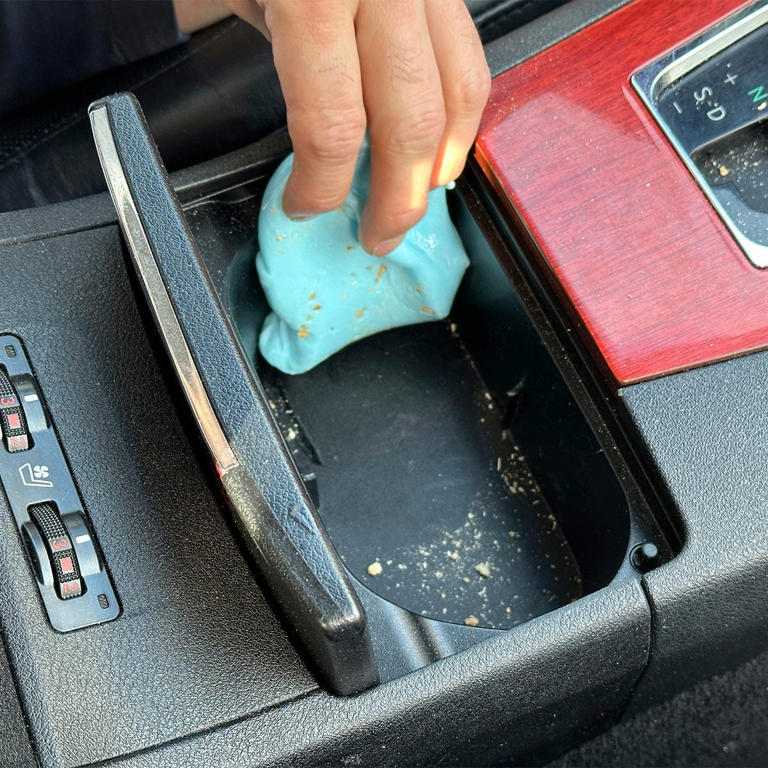
- Cup holders
- Door-pocket bottoms
- Console storage areas
- Around, but not inside, air vents
- Flat areas with loose dust and crumbs
Turn the car off before cleaning. Remove jewelry that could scratch trim.
Safe cleaning steps
- Remove large debris first. Pick up coins, wrappers, and stones by hand.
- Test a hidden spot. Press a small piece of gel on an unseen area for a few seconds.
- Inspect the surface. Stop if the color changes, the surface becomes dull, or residue appears.
- Press, then lift. Do not rub the gel across the surface.
- Use a fresh section often. Fold the dirty part inward.
- Stop when the gel looks dirty. A contaminated gel can spread grime.
- Wipe the area with a clean microfiber towel.
Do not press the gel into narrow vents, speaker holes, seams, switches, or buttons. It can break apart and leave pieces behind.

Where You Should Not Use Homemade Cleaning Slime
Avoid cleaning slime on materials that can trap residue or react with water and chemicals.
Do not use it on:
- Cloth seats
- Carpet
- Headliners
- Suede or microsuede
- Perforated leather
- Open-pore wood
- Peeling or cracked dashboards
- Sticky soft-touch coatings
- Seat belts
- Touchscreens
- Instrument clusters
- Speaker grilles
- Air vents and fan openings
- Steering wheels or pedals
A steering wheel needs a clean, dry grip. Slime residue could make it slippery. Never place gel near brake, accelerator, clutch, or parking-brake controls.
For screens, use the vehicle maker’s cleaning directions and a soft, dry microfiber cloth unless the manual says otherwise.
How to Use Pine-Sol Safely in a Car
Use Pine-Sol separately from the gel. First, check the bottle label and your vehicle owner’s manual. Product formulas and directions can change, so follow the instructions for the exact Pine-Sol product you own.
A cautious method is:
- Ventilate the car. Open the doors or windows.
- Dilute the product exactly as the label says.
- Put the diluted cleaner on a microfiber cloth. Do not spray it into vents, switches, speakers, or electronics.
- Test a hidden area.
- Wipe only approved, washable surfaces.
- Follow with a clean damp cloth if the label and material allow it.
- Dry the area fully.
Do not use Pine-Sol on leather, suede, fabric, screens, or delicate trim unless both the vehicle material instructions and the product label allow it. Do not use it on a hot dashboard or in direct heat.
Never mix Pine-Sol with:
- Bleach
- Ammonia
- Vinegar
- Toilet cleaner
- Drain cleaner
- Rubbing alcohol
- Another household cleaner
Mixing cleaning products can release harmful vapors or cause unwanted chemical reactions. If a strong odor, eye irritation, coughing, or breathing trouble occurs, leave the vehicle and get fresh air. Contact Poison Control in the United States at 1-800-222-1222 for exposure guidance.

Homemade Car Cleaning Slime Troubleshooting
Small changes can affect the gel. Use this guide before adding more ingredients.
| Problem | Likely cause | Safer correction |
|---|---|---|
| The gel is watery | Not enough activator or poor mixing | Add contact solution a few drops at a time |
| The gel is very sticky | Too much water or too little activator | Knead longer, then add a few drops of contact solution |
| The gel is hard | Too much activator | Knead in a few drops of water |
| The gel breaks apart | Excess activator or old ingredients | Make a fresh batch |
| The gel leaves a film | Surface or recipe is unsuitable | Stop and wipe with a clean, damp microfiber cloth |
| The gel smells strong | Fragrance or cleaner was added | Discard it; do not add Pine-Sol |
| The gel will not pick up dust | The surface is greasy or wet | Clean and dry the surface first |
Do not keep adding products to rescue a failed batch. A fresh, small batch is safer than trying to balance several household chemicals.
Discard the gel if it changes color, grows mold, smells sour, or becomes difficult to remove. Keep it away from children and pets. It is not edible, even when made with common household ingredients.
How Long Does Car Cleaning Slime Last?
Homemade gel has no reliable shelf life. Its condition depends on the ingredients, storage container, heat, and moisture.
For best results:
- Store it in a sealed container
- Keep it in a cool place
- Do not leave it in a hot car
- Keep it away from direct sunlight
- Check it before each use
- Discard it when it becomes dirty or changes texture
Do not store the gel in the vehicle during summer heat. High temperatures can make it melt, separate, or stick to the container.
Use a small amount at a time. Once the gel has picked up dust, oils, or crumbs, do not press it onto another clean area.
Is Pine-Sol Good for Cleaning a Car Interior?
Pine-Sol may be suitable for some washable hard surfaces when used exactly as the label directs, but it is not a universal car interior cleaner.
A car contains many material types. Vinyl, coated plastic, leather, fabric, rubber, painted trim, and electronic screens can react differently to the same product. A cleaner that works on a plastic cup holder may dull a dashboard coating or leave a film on a steering wheel.
For routine interior care:
- Use a vacuum for loose dirt
- Use a dry microfiber cloth for screens
- Use a material-specific cleaner for leather and fabric
- Use a soft brush for seams and vents
- Use the mildest product that solves the problem
If the surface is cracked, peeling, faded, or sticky, avoid homemade cleaners. A professional detailer or the vehicle manufacturer’s care instructions can help identify the material and the right repair or cleaning method.
Frequently Asked Questions
Can I add a few drops of Pine-Sol to slime?
It is not recommended. Even a small amount can change the gel’s texture and may leave cleaner residue. Pine-Sol should be used separately and only as directed on the product label.
Does car cleaning slime disinfect surfaces?
No. Homemade slime is a dust and crumb pickup tool. It has not been tested or approved as a disinfectant. Use an appropriate disinfecting product only when the label allows it for the specific car material.
Can I use cleaning slime on leather seats?
Avoid it. Leather has a finish that can be affected by moisture, residue, and friction. Use a leather cleaner approved for the seat’s finish and test it in a hidden area.
Why did the slime stick to my dashboard?
The dashboard may have a soft-touch coating, heat-softened residue, or a textured surface. Stop pulling at it. Lift small pieces with a clean microfiber cloth, then follow the vehicle and material cleaning instructions.
Can I reuse the same slime?
You can reuse it for a short time if it remains clean and stable. Fold dirty areas inward and discard the gel when it becomes visibly soiled, sticky, crumbly, or hard to remove.
Key Takeaways
- Do not mix Pine-Sol into homemade car cleaning slime.
- Make a plain gel with glue, water, baking soda, and suitable contact solution.
- Test the gel on a hidden hard surface first.
- Press and lift; never rub it into vents, seams, or electronics.
- Keep it away from screens, leather, fabric, steering wheels, and pedals.
- Use Pine-Sol separately, diluted exactly as its label directs.
- Never mix Pine-Sol with bleach, ammonia, vinegar, alcohol, or other cleaners.
Conclusion
The safest way to make car cleaning slime is to leave Pine-Sol out of the recipe. A simple glue-based gel can pick up loose dust and crumbs from selected hard surfaces, while Pine-Sol should remain a separate, label-directed cleaner.
Start with a small batch, test it in a hidden spot, and stop at the first sign of residue or surface damage. For delicate materials or valuable interiors, use a product made for that material or ask a professional detailer for help.